
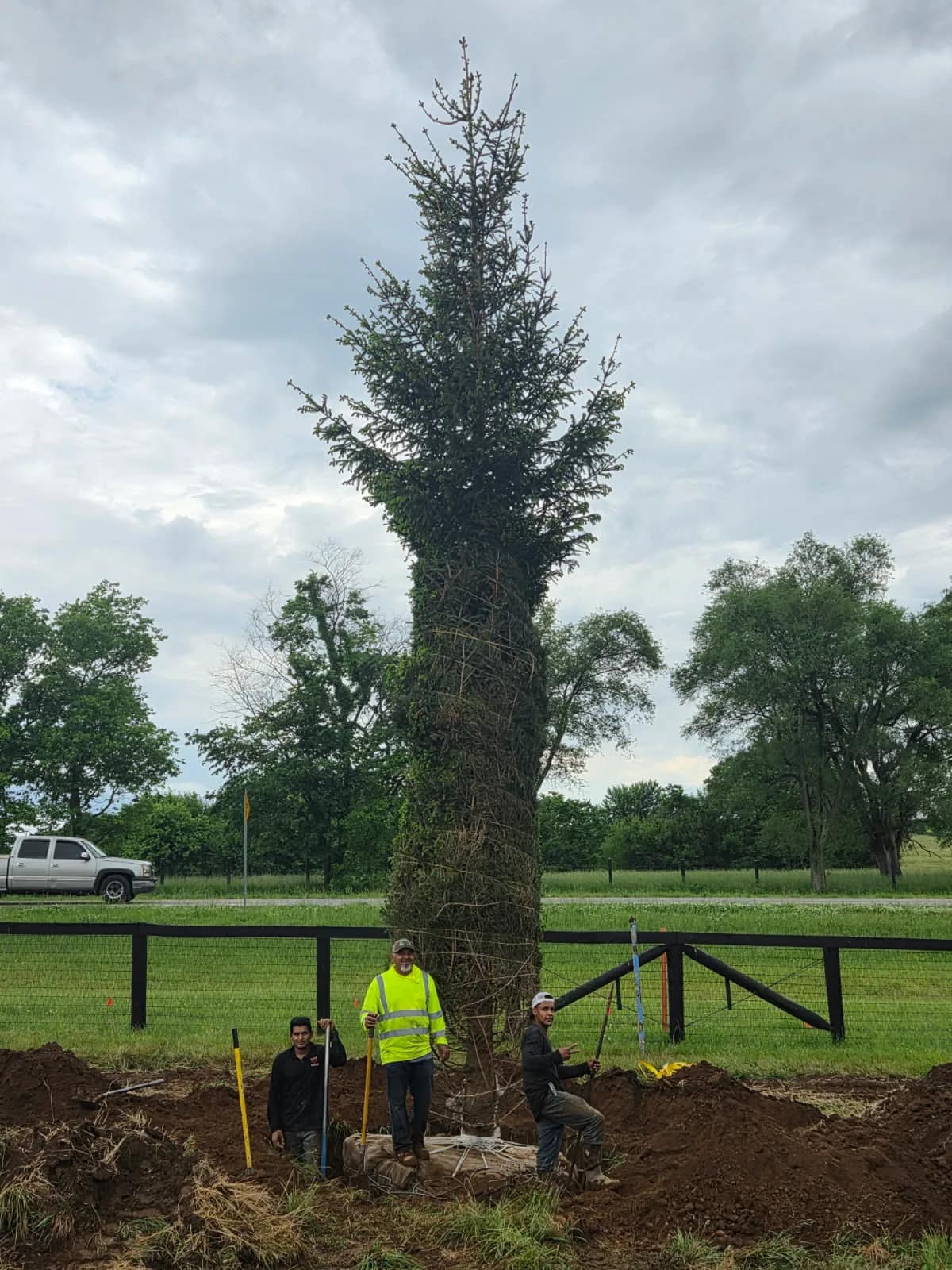
MOST PEOPLE ASK FOR HEIGHT
Orlando Also Asks About the Root Ball and the Way In
Customers often begin with, “What is the biggest tree you can bring?”
Orlando's next questions are usually about what the tree needs to accomplish, how the crew will reach the planting location, and how the tree will be watered.
A tall tree may provide faster privacy or more immediate presence. It also arrives with a larger root system, more weight, and fewer easy ways to move it through a narrow gate or across soft ground.
HEIGHT IS ONLY ONE MEASUREMENT
Trees Are Not All Sold the Same Way
Deciduous shade and flowering trees are commonly sold by trunk caliper. Evergreens are often described by height. Some ornamental trees may be sold by height, container size, or both.
That means a ten-foot tree does not tell the entire story. The species, trunk thickness, root ball, canopy, growing method, and condition of the tree all matter. A full, healthy eight-foot evergreen may be more useful than a thin ten-foot tree selected only because it is taller.
A PRACTICAL STARTING-SIZE COMPARISON
Enough Tree to Matter Without Ignoring the Rest of the Project
These are starting conversations, not universal prescriptions. Species, nursery stock, site conditions, and the shape of the individual tree can change the recommendation.
| Nursery description | Where it may fit | Main advantage | Main consideration |
|---|---|---|---|
| 1.5 to 2-inch caliper deciduous tree | Residential lawns, replacement trees, and multiple-tree projects | Easier access and generally quicker establishment | Less immediate canopy |
| 2 to 3-inch caliper deciduous tree | Front yards, estates, and commercial entrances | More visible structure at planting | Larger root ball and higher material and installation cost |
| More than 3-inch caliper specimen | Large properties and important focal locations | Immediate scale and presence | Equipment, access, watering, and establishment become major parts of the project |
| 6 to 8-foot evergreen | Longer privacy rows and budget-conscious planting | Useful balance between coverage and handling | More time before the screen fills in |
| 8 to 10-foot evergreen | Residential privacy and property-line planting | Stronger immediate coverage | Larger root balls and more demanding delivery |
| 12-foot and larger evergreen | Estate screening, large-property scale, and immediate impact | Changes the view quickly | Specialized handling, access, irrigation, and higher cost |
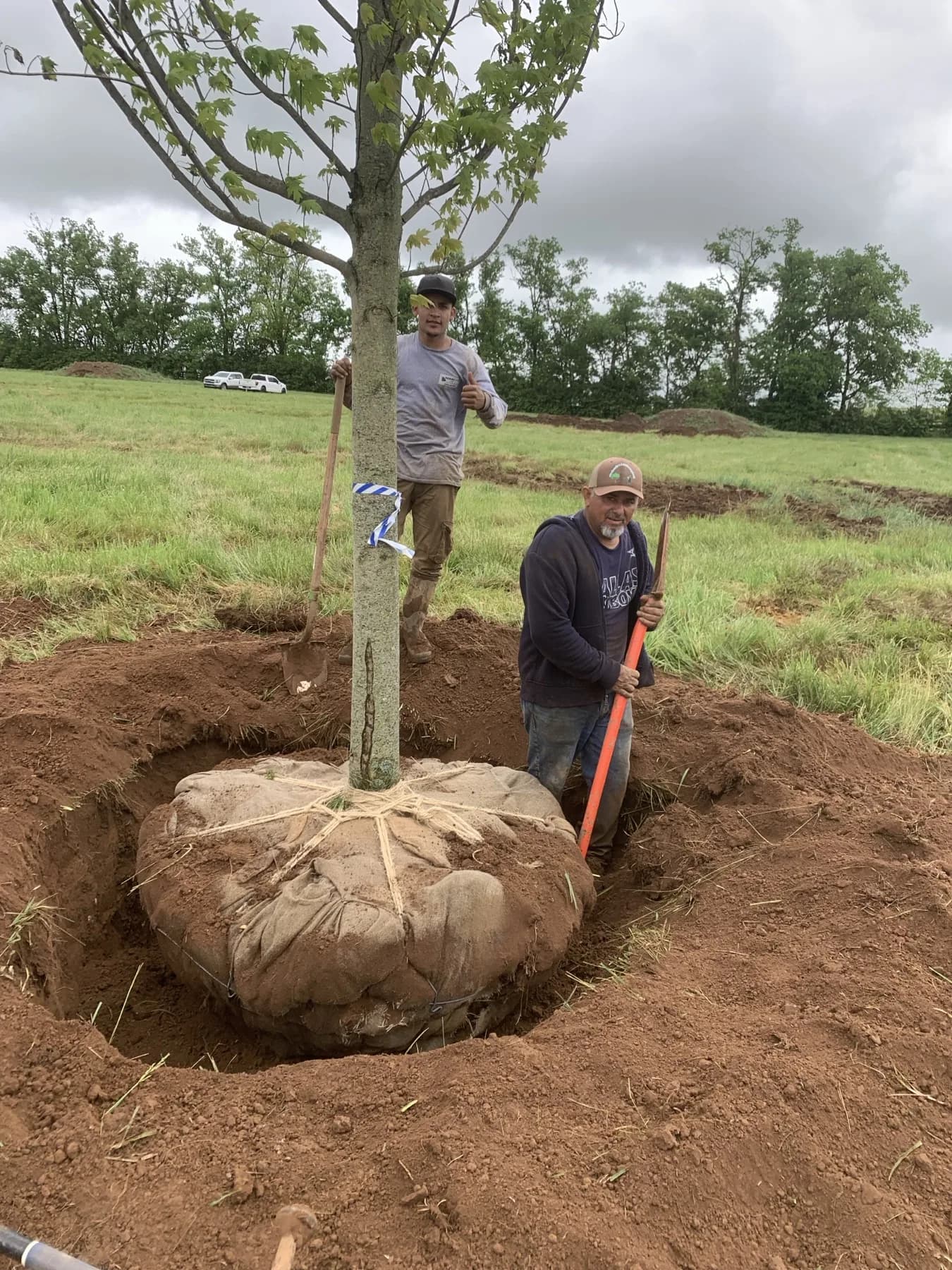
BIGGER ABOVE GROUND MEANS BIGGER BELOW GROUND
The Root Ball Changes the Entire Installation
A commonly used nursery guideline is approximately 10 to 12 inches of root-ball diameter for each inch of trunk caliper. A two-inch-caliper tree may therefore arrive with a root ball roughly 20 to 24 inches across.
That affects more than the planting hole. It affects trailer space, equipment, gate clearance, soil conditions, and how much disturbance is required to reach the final location.
Photographs of both the planting location and the access route are useful when estimating large-tree planting.
Read the Utah State University nursery stock guidance.A REAL KENTUCKY PROJECT
The 26-Foot Spruce Was Only One Part of the Decision
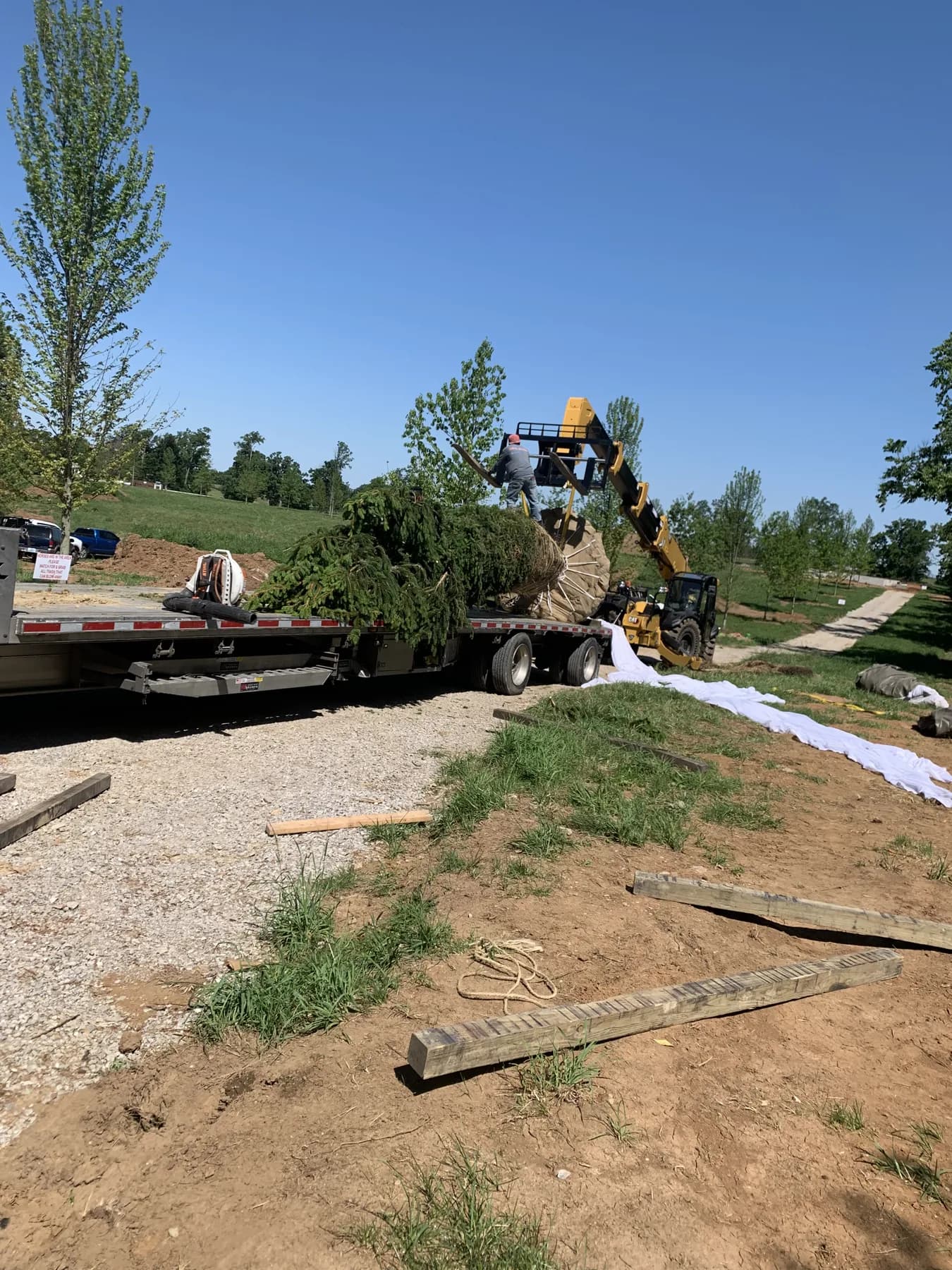
On a farm project in Paris, Kentucky, our crew planted 113 trees. The project included 45 Norway spruce and 68 oak and maple trees. Some of the spruce were approximately 26 to 27 feet tall.
At that size, selecting the tree was only the beginning. The crew needed room to unload, move, position, and plant the root balls. The rows had to work with the scale of the property. Irrigation was installed to reach every tree.
That project made sense because the property, access, equipment, crew, and watering plan all supported the size.
See the Paris farm planting project.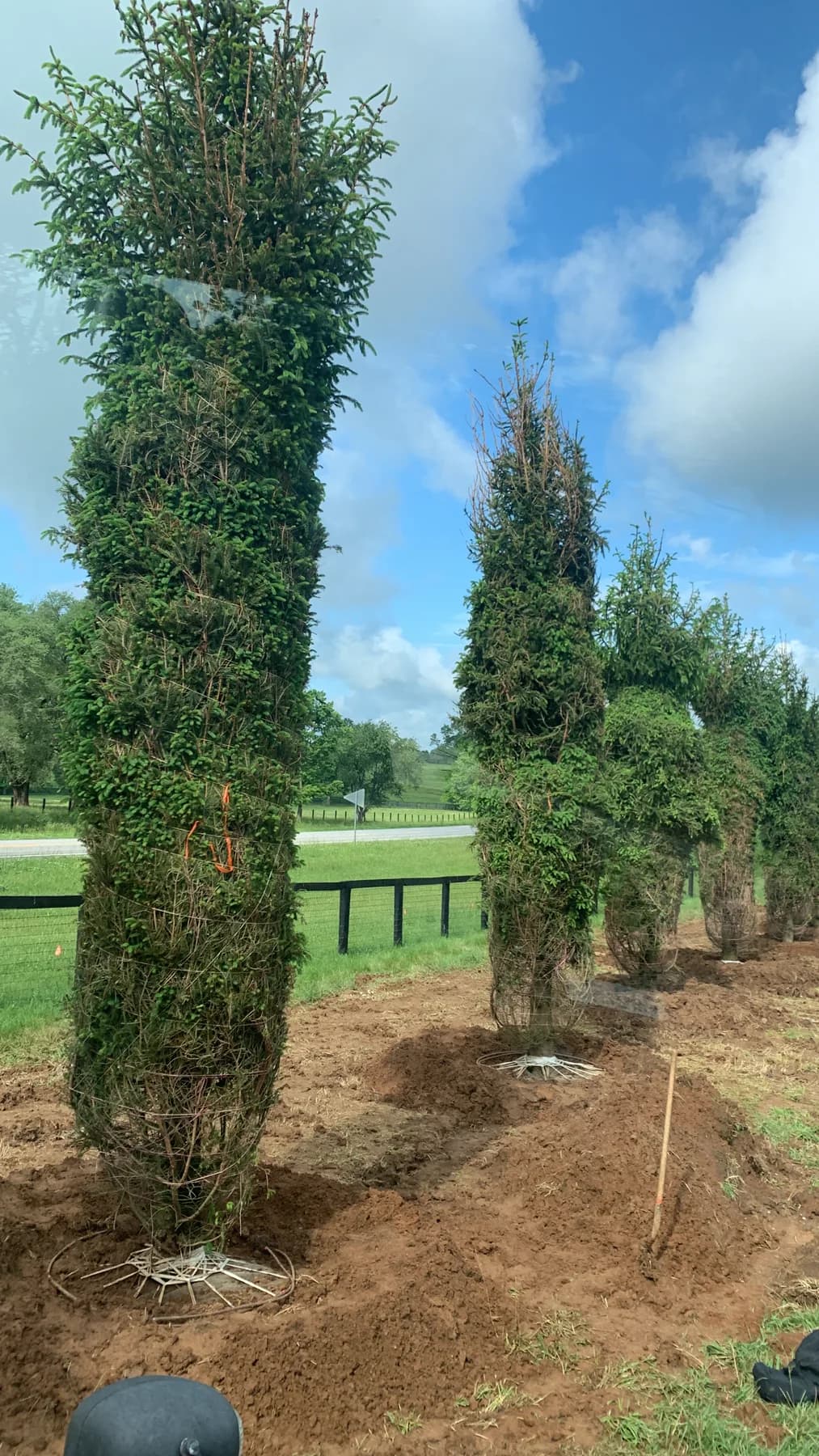
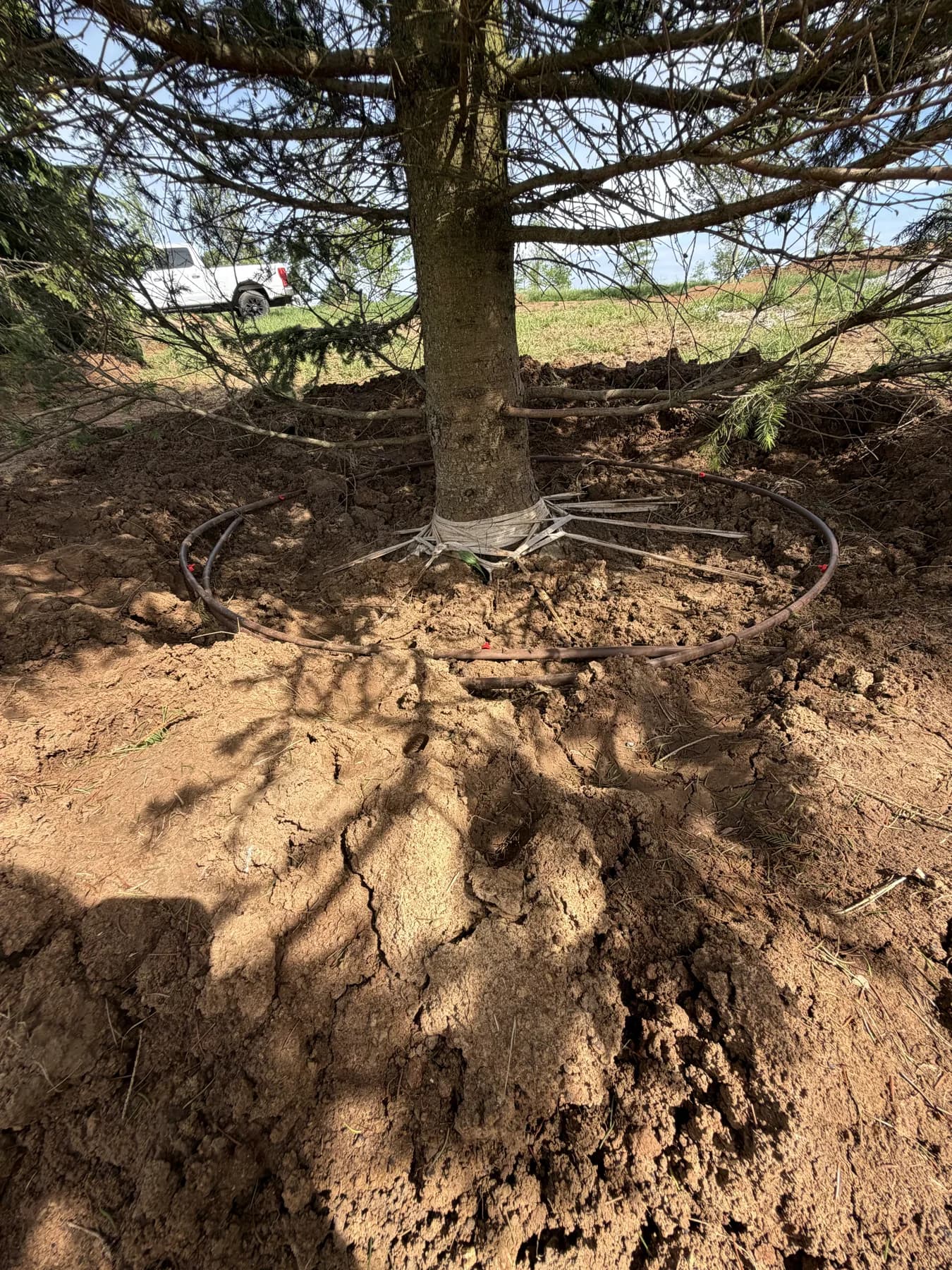
WHEN A SMALLER TREE IS BETTER
Smaller Does Not Mean Worse
- The planting location has narrow or difficult access.
- The budget needs to cover several trees instead of one specimen.
- The property does not have dependable irrigation.
- Immediate height is less important than long-term establishment.
- The tree is going into a confined lawn or landscape bed.
- The larger nursery stock available is thin, damaged, or poorly shaped.
Larger-caliper trees generally require more time to reestablish their root systems. Cornell gives a practical rule of roughly one year of establishment for each inch of trunk caliper, while emphasizing that the site and care still matter.
Read the Cornell Urban Trees guidance.WHEN A LARGER TREE IS WORTH IT
Immediate Impact Can Be the Point
- A patio, road, window, or property line needs coverage sooner.
- A large home or estate needs a tree that does not disappear against the property.
- A prominent tree was lost and the open space feels unfinished.
- A commercial entrance needs immediate structure.
- The property has suitable access and a dependable watering plan.
The decision should be based on what the larger tree changes, not simply on whether it is available.
CONTAINER-GROWN OR BALLED AND BURLAPPED?
Both Can Produce Good Trees
Container-grown trees are easier to handle in many residential situations, but roots should be inspected for circling or confinement. Balled-and-burlapped trees allow nurseries to move larger field-grown material, but the root ball must be handled carefully and the tree must be planted at the correct depth.
Stock type is one part of the decision. Tree health, root condition, species, starting size, and planting quality matter more than treating either method as automatically superior.
WHAT TO SEND US
You Do Not Need to Know the Exact Size First
- A photograph of the area you want to change
- A photograph showing the access route
- The property address
- What you want the tree to accomplish
- Whether irrigation or a nearby water source is available
- Whether immediate impact or lower starting cost matters more
From there, we can compare the species, size, access, installation, and likely project cost. See the tree planting cost guide for the other factors that affect an installed price.
FAQ
Common Questions
Do smaller trees establish faster?
Often they can, because smaller root balls are easier to handle and water. The best size still depends on the goal, species, and site.
What does tree caliper mean?
Tree caliper is the diameter of a young tree trunk measured near the base. Nurseries commonly use caliper to describe the starting size of deciduous shade and flowering trees.
What size evergreen should I plant for privacy?
Six to eight-foot evergreens can balance coverage and handling on longer rows, while eight to ten-foot trees provide more immediate presence. Species, row length, access, budget, mature width, and watering determine the right choice.
How large is the root ball on a two-inch-caliper tree?
A common nursery guideline is about 10 to 12 inches of root-ball diameter per inch of trunk caliper. A two-inch-caliper tree may therefore have a root ball roughly 20 to 24 inches across, although nursery standards and species can change the final dimensions.
Is a larger tree worth the extra cost?
It can be when privacy, property scale, or immediate impact matters and the site has suitable access and dependable watering. Larger stock is not automatically the better choice for every property.
TREE SIZE AND ESTABLISHMENT GUIDANCE
Sources Used for This Guide
Size and establishment guidance are based on university extension resources, combined with our experience delivering and planting trees on Kentucky properties.
SEND US THE VIEW AND THE ACCESS ROUTE
We Will Help You Choose the Starting Size
We can help determine whether the project needs a smaller tree that can establish efficiently, a larger tree for immediate impact, or something between the two.